Product Description
Principle of operation
The SNSPD is composed of a thin film of superconducting material patterned into a meandering nanowire using nanofabrication techniques. This design allows for efficient coupling of the detector to an optical fiber or free-space light input. The detectors operate well below the critical temperature of the superconducting material, typically at around 2.5 K, with a constant bias current applied that remains below the detectors’ critical current. A simplified model of the detector’s operation is as follows (Simplified operating principle of SNSPD.): when a single photon is absorbed, superconductivity is locally disrupted, creating a so-called hot spot. Within this region, quasiparticle interactions cause the hot spot to expand, leading to areas of increased current density around it. The elevated current density eventually forces the surrounding superconducting regions to transition into a resistive state, forming a resistive barrier across the nanowire. This results in a redistribution of current within the electrical circuit, generating a voltage pulse that is transmitted to an amplification circuit. As the current redistributes, the nanowire cools and regains its superconducting state. Once superconductivity is fully restored, the bias current resumes flowing through the nanowire, preparing the detector for the next photon detection event. However, if a subsequent photon arrives before the nanowire has fully recovered, the detector’s efficiency will temporarily decrease, leading to a loss in detection efficiency at higher count rates (shorter arrival times of photons). The nanowire’s specific design makes it sensitive to the polarization of the incoming electromagnetic wave. If the polarization is not aligned with the nanowire’s meander structure, the probability of a detection event decreases. Additionally, due to the implementation of an optical cavity, detection efficiency is wavelength-dependent. Despite this, the detector remains sensitive across a broad wavelength range, typically extending from the visible spectrum to the short-wave infrared range. In this range, sensitivity is primarily limited by the transmission properties of the optical fiber.
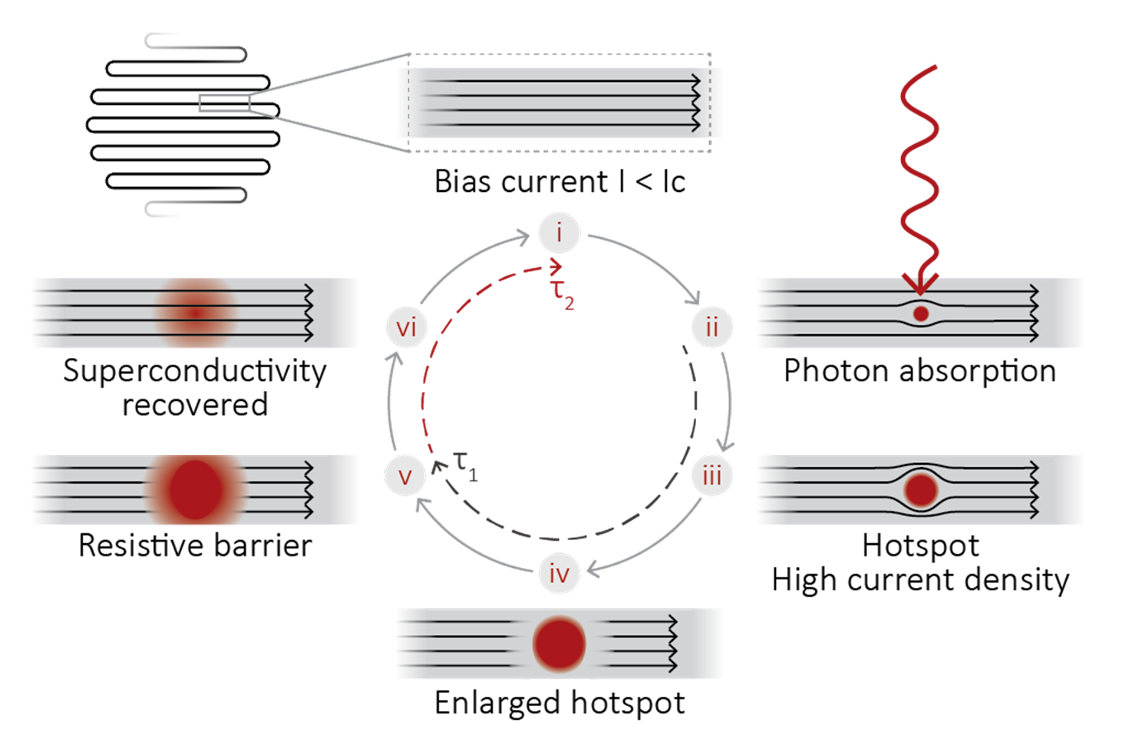
Simplified operating principle of SNSPD.
Main metrics
For a SNSPD system, several key performance metrics determine its effectiveness and reliability. These include:
System detection efficiency refers to the probability (typically expressed as a percentage) of detecting a single photon coupled to the detector’s input. The term system emphasizes that all losses, including insertion, propagation, and coupling, are already accounted for in the stated probability. This metric is highly dependent on the device’s bias current and the wavelength of the incoming light.
Dark count rate indicates the number of false counts a detector generates, and is measured in the absence of an input signal. This metric also depends on the detector’s bias current. To accurately measure a dark count rate of <=50 counts per second, the integration time should be increased to minimize statistical error.
Jitter, also known as temporal resolution, describes the timing precision of the detector. It is defined by the variation in the time interval between the arrival of an optical signal at the detector and the corresponding electrical response. Jitter decreases as the bias current is increased.
High count rate refers to the detector’s ability to achieve count rates in the megacounts-per-second range without a significant loss of system detection efficiency.
Main components
Single Quantum systems consist of five essential components: the cryostat, helium compressor, vacuum pump, electronic driver, and computer. There are many models available for each option, so that there are configurations suitable for all requirements. Furthermore, Eos cryostats can be upgraded to accommodate more SNSPD channels, or SNSPDs with sensitivity at different wavelengths. Please contact the Single Quantum sales department if you would like more information, using the contact details listed in Contact. The arrangement and connections of system components are illustrated in Figure 2.2. Detailed information about each component is provided in the following sections.
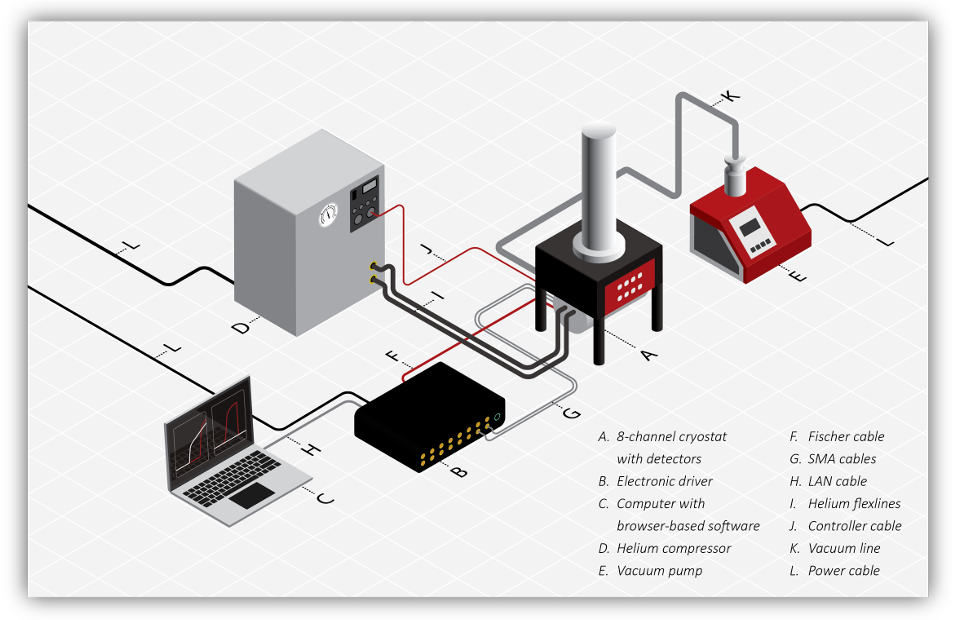
Single Quantum Eos 8 system setup.
Cryostat
Single Quantum cryostats are based on closed refrigeration cycle which uses helium gas to cool SNSPDs down to their operating temperature. Depending on application, required form-factor, and number of SNSPD channels, Single Quantum offers different cryostat models:
Eos 8: up to 8 fiber-coupled SNSPD channels.
Eos 24: up to 24 fiber-coupled SNSPD channels of any types and configurations.
Eos R12: up to 12 fiber-coupled SNSPD channels of different types in a compact rack-mountable (19”) body.
Iris X: designed for detector arrays and free-space coupling. The dimensions of these cryostats are summarized in the following table.
Model |
Height (mm) |
Depth (mm) |
Width (mm) |
Weight (kg) |
|---|---|---|---|---|
Eos 8 |
590 |
340 |
240 |
19 |
Eos 24 |
630 |
450 |
300 |
27 |
Eos R12 |
130 |
610 |
438 |
20 |
Iris X |
650 |
450 |
300 |
30 |
Typical dimensions and weights of Single Quantum cryostats.
Helium compressor
Helium compressors supply high-pressure helium gas to the cold head and return low-pressure helium gas for recirculation. Most Single Quantum systems are compatible with standard Sumitomo waterand air-cooled compressors (see Table 2.2). These compressors are interchangeable, allowing for replacement or upgrades as needed. Each unit weighs approximately 80 kg.
Model |
Height (mm) |
Depth (mm) |
Width (mm) |
Type |
|---|---|---|---|---|
Sumitomo CNA-11C |
610 |
450 |
383 |
air-cooled |
Sumitomo CNA-11RC |
400 |
700 |
484 |
air-cooled; rack-mountable |
Sumitomo F-20L |
617 |
453 |
444 |
water-cooled |
Dimensions of standard Sumitomo Cryogenics compressors compatible with Single Quantum cryostats
Due to their power consumption, helium compressors must be connected to electrical circuits with a minimum amperage of 16 A. For detailed information on compressor requirements, please consult the OEM manual or contact Single Quantum’s support team using the details in Contact.
Vacuum pump
For each cool-down of a Single Quantum system, it is necessary to evacuate residual gases from the cryostat using a high vacuum pump. Single Quantum systems are compatible with any oil-free vacuum pump capable of achieving high vacuum levels (preferably <1E-5 mbar) and compatible with ISO-KF vacuum flange fitting. The vacuum pump must remain operational throughout the entire cool-down process and until the system reaches its base temperature, after which it can be disconnected. For full instructions on the cool-down process, please see Cryostat.
Driver
Single Quantum offers two electronic driver models tailored for SNSPD systems: the Atlas driver and the Retina driver. These provide the SNSPDs with a tunable DC bias current, and amplify the output signal. Both drivers feature a user-friendly browser-based interface, ensuring straightforward detector control and signal readout. The Atlas driver is optimized for smaller-scale setups, supporting up to 8 SNSPD channels. In contrast, the Retina driver offers unlimited scalability, seamlessly integrating additional SNSPD channels into the user interface. Its rack-mountable design also enhances system organization and adaptability for larger-scale operations. Both driver models support the use of auxiliary 50 Ωimpledance matched electronics, such as oscilloscopes, time taggers, or TCSPC electronics, which can be directly connected to the driver’s output port.
NOTICE Note that driver channels could be optimized for operation with specific cryostat channels (SNSPDs) in your system. Always use the mapping of cryostat to driver channels indicated on your system’s charachterization sheet.
Optional components
Single Quantum systems can be equipped with various components available upon request:
polarization controllers
housing rack
computer
vacuum pump
optical fibers
TTL signal converter
electronic gating
time tagging or TCSPC electronics
jitter stabilizer for high count rates. If you are interested in upgrading your system with any of these optional components, or with more detectors or those with higher performance, please reach out to our sales team via the contact details given in Contact.